
Welcome to the place of wisdom
How naked are we when we are naked?
How Naked Are We When We Are Naked?
The Loneliness of Being Touched Without Being Felt
I have been thinking a great deal about intimacy lately after one session with the woman, who totally lost everything for her husband. How is it possible to spend decades sleeping beside another human being and still experience profound loneliness? How can a single conversation with someone awaken more of us than years of physical intimacy with another person? Why can the memory of a particular touch remain alive in our bodies long after the person who touched us is gone?
We have developed an entire vocabulary around sexual compatibility, attraction, chemistry, desire, and physical pleasure. We discuss techniques, preferences, frequency, and satisfaction. Yet some of the most fascinating dimensions of human sexuality remain largely unexplored in our everyday conversations. What exactly are we exchanging when we become intimate with another human being? How much of that exchange takes place beyond our conscious awareness? And how much of ourselves do we actually allow another person to encounter when we take off our clothes?
A man can desire a woman's body intensely without having much curiosity about the consciousness inhabiting that body. He can know exactly how to bring her to orgasm and have very little understanding of what makes her feel alive. He can spend years sleeping beside her without ever discovering the complexity of her inner world. The same, of course, is true of a woman in relation to a man. She can know his habits, his responsibilities, his preferences, and the predictable patterns of his behavior while remaining almost entirely unfamiliar with his deepest desires, fears, intellectual longings, and internal contradictions.
Physical proximity can coexist with an astonishing degree of emotional, intellectual, and spiritual distance. Two people can share a bed, a home, children, financial responsibilities, and decades of their lives while remaining profoundly unknown to one another. This is one of the great paradoxes of human relationships. We can grant another person access to the most private parts of our bodies while keeping the most intimate parts of our consciousness carefully protected.
During Thanksgiving dinner, I happened to have a conversation with a man who is approaching ninety. His wife passed away years ago, and about four or five years ago, he fell in love with another woman. What he shared with me that evening is something I felt inside for a long time. We were holding hands, he was crying and confessing... even though he was never a religious man. He told me that he had never been as happy in his entire life as he is now after meeting his lady. Looking back, one of his greatest regrets was that he had never truly allowed himself to be happy. He now realizes that he could have found a way to care for his wife back then, honor his responsibilities, and still make his own happiness a priority. His kids didn't approve him falling in love EVEN after their mother died. I find it a bit selfish... however, he waited all his life and even after her death, he was judged... For most of his life, however, he had lived according to a different set of priorities: responsibility, duty, and financial stability. What saddened him most was the realization that his life was nearing its end, and only now was he discovering how much life there actually was to live. How much joy, tenderness, love, and excitement he was capable of experiencing. How much of himself had remained unexplored for all those years.
He is a former Marine. A man who spent much of his life guided by duty and responsibility. And there he was, approaching ninety, telling me that he wished he had given himself permission to be happy much earlier... I kept thinking about our conversation long after Thanksgiving dinner was over. How many of us spend our lives being responsible for everything and everyone around us while gradually abandoning our responsibility toward our own existence? How many of us postpone living until our obligations have been fulfilled, only to discover that there will always be another obligation? It never stops... And what if, at the end of our lives, one of our greatest regrets is how little of our own humanity we allowed ourselves to experience?
The intelligence of the body
In recent years, my own experience of human interaction has changed considerably. I have become increasingly sensitive to the emotional and internal states of other people, and this sensitivity manifests itself through very specific physical processes. I experience changes in my breathing, sensations in my chest and abdomen, muscular tension, and sudden shifts in my internal state. Sometimes these changes occur before a single word has been exchanged. What has become particularly fascinating to me is learning to distinguish between my own internal processes and the sensations that arise within me in response to another human being.
There have been situations in which I could physically experience what I recognized as another person's fear while listening to them speak. My chest would tighten, my breathing would change, and my body would respond to something that had very little to do with my own emotional circumstances at that particular moment. When the interaction stopped, the sensations would gradually disappear. Observing these processes has taught me an enormous amount about the nature of perception, the relationship between consciousness and the body, and the complexity of the information we exchange with one another.
Through my own experience, I have come to understand this exchange as a form of resonance. Something occurs within another human being, my body responds, and my consciousness begins to recognize the experience through physical sensations, emotions, or impressions. One of the most challenging aspects of developing this sensitivity is learning to remain sufficiently present within myself to distinguish the original sensation from the interpretation my mind immediately begins to construct around it. The sensation itself can be remarkably clear, while the explanation my mind produces may be influenced by my own memories, fears, expectations, and desires. Learning to separate these processes requires considerable awareness.
This is why I follow with particular interest the work of researchers exploring the electromagnetic dimensions of consciousness. The research involving Marco Cavaglià and Tommaso Firaux explores the possibility that consciousness involves interactions between biological processes, electromagnetic activity, and information. I find the analogy of the brain as an antenna particularly interesting. The electrical activity of the brain and nervous system generates electromagnetic fields, as does the electrical activity of the heart. Researchers at the HeartMath Institute have also investigated the electromagnetic activity of the heart and its potential relevance to interpersonal communication.
Science has documented numerous ways in which human beings influence one another physiologically. Our nervous systems respond to social interactions, our emotional states affect those around us, and our bodies continuously process information that never reaches our conscious attention. While the precise role of electromagnetic fields in transmitting emotional information remains under investigation, my interest in these questions originates in something deeply personal. I recognize aspects of the phenomena these researchers are attempting to understand through my own lived experience. I am increasingly interested in the relationship between sensitivity and consciousness, in how information becomes a physical sensation, how that sensation enters awareness, and how we gradually learn to recognize its meaning. I wonder how much information passes through us every day without our ever becoming conscious of it, and how differently we might approach human relationships if we became more aware of these exchanges. And if so much can happen between two people simply sitting beside one another, imagine the complexity of the exchange taking place during sexual intimacy.
What are we actually exchanging during sex?
Consider what happens when two human beings come together sexually. Their breathing changes, their heart rates accelerate, their nervous systems respond to one another, their hormonal activity shifts, and their attention becomes concentrated within a shared physical experience. Their bodies are communicating continuously through touch, temperature, movement, muscular tension, sound, rhythm, and countless other signals. At the same time, each person brings into that encounter an entire psychological universe: memories, emotional wounds, desires, fears, expectations, unconscious patterns, beliefs about sexuality, and their individual capacity to experience vulnerability.
What fascinates me is the quality of consciousness that each person brings into this exchange. What is happening within the man who is touching a woman? Is he experiencing tenderness, gratitude, curiosity, admiration, fear, guilt, frustration, loneliness, or simply the desire to release accumulated sexual tension? What is happening within the woman receiving his touch? Is she experiencing pleasure, emotional openness, anxiety, obligation, the need for validation, the desire to be chosen, or the fear of disappointing him? How many of these states can coexist within a single sexual encounter, and how much of this information is being communicated between them without either person consciously acknowledging it?
Another angle to explore is this one: what happens when a person maintains intimate relationships with more than one partner? How much of what has been experienced within one relationship is subsequently carried into another? And how aware are we of the psychological, emotional, and potentially energetic information we may be bringing into someone else's intimate space?
One particularly fascinating phenomenon is the gradual emergence of similar emotional responses, behavioral patterns, and even personality traits among people who share an intimate connection with the same person. Two individuals who have never had a meaningful interaction with one another may eventually begin exhibiting remarkably similar characteristics. What exactly is happening in such circumstances? Can a person become an unconscious carrier of psychological, emotional, and energetic information between different intimate environments?
I have come to regard sexual intimacy as one of the most profound forms of human exchange. During intimacy, we allow another person extraordinary access to our physical and emotional worlds. Our usual psychological defenses may soften, our attention becomes receptive, and our bodies participate in an interaction whose complexity extends far beyond what we consciously perceive. What interests me is the possibility that this exchange includes information we would never consciously choose to receive. We may absorb another person's tenderness, creativity, joy, sensuality, and intellectual vitality, while simultaneously becoming exposed to their unresolved fears, internal conflicts, emotional dependencies, and unconscious behavioral patterns.
Consider a man who has spent decades adapting to a particular emotional environment. His nervous system has become accustomed to certain expectations, fears, conflicts, control, and ways of responding to intimacy. He may have developed mechanisms of avoidance, secrecy, emotional withdrawal, self-censorship, or the need to constantly manage another person's reactions. These mechanisms gradually become part of his psychological functioning, and he carries them wherever he goes, including into his sexual relationships.
When another woman opens herself intimately to such a man, she encounters the entire psychological reality he carries within himself. Over time, she may begin experiencing emotional states and exhibiting behavioral patterns that were previously unfamiliar to her. An independent, emotionally secure, and otherwise self-aware woman may gradually find herself experiencing anxiety, suspicion, jealousy, competition, or the need for constant reassurance. She may suddenly discover herself participating in a relational drama, wondering how on earth such dynamics became part of her existence. How much of this transformation originates in her own unconscious patterns? How much develops in response to deception, broken promises, and prolonged uncertainty? And how much reflects the emotional and psychological information that the man continuously carries into their intimate space?
A woman may find herself responding to psychological defenses that were originally developed in response to someone else. If a man has spent decades concealing his desires, avoiding uncomfortable conversations, anticipating criticism, or managing another person's fear of abandonment, he may continue reproducing these mechanisms even in the presence of a woman who initially had no desire to restrict his freedom. Eventually, his behavior may awaken within her some of the very characteristics from which he was seeking relief.
This creates a fascinating psychological paradox. A person may attempt to escape a particular relational dynamic while unconsciously carrying the very mechanisms that reproduce it wherever they go. And the exchange can move in both directions. A man may bring into his established relationship the intellectual curiosity, tenderness, sensuality, emotional openness, creativity, and new perspectives he has encountered through intimacy elsewhere. His partner may begin experiencing changes in him without understanding their origins. Through continued interaction and sexual intimacy, some of these qualities may gradually become part of her own experience as well.
A woman may contribute enormously to a man's psychological, emotional, intellectual, sexual, and spiritual development, while the benefits of that transformation eventually become available to another person. Meanwhile, her own emotional well-being may deteriorate through prolonged exposure to unresolved conflicts, fears, and behavioral patterns circulating within his other relationships. The exchange can become profoundly asymmetrical. One person contributes vitality, awareness, creativity, and love, while gradually finding herself entangled in psychological dynamics she never consciously chose.
I find the possibility of a deeper exchange occurring through sexual intimacy itself particularly fascinating. If our bodies are continuously receiving and responding to information from other human beings, what happens when we enter one of the most physically and emotionally receptive states available to us? Could sexual intimacy facilitate the exchange of emotional and psychological information on levels that we are only beginning to understand? Could certain patterns become incorporated into our own experience before we have developed the awareness necessary to recognize their origins?
The precise mechanisms of such an exchange remain open to investigation. Nevertheless, I believe these questions deserve considerably more attention, particularly when we consider how profoundly human beings can influence one another through prolonged intimate contact. We speak extensively about sexual health and physical hygiene. We understand the importance of protecting our bodies from infections and other physical consequences of sexual contact. Yet how often do we consider the psychological, emotional, and energetic hygiene of our intimate relationships?
What has the person entering our intimate space been carrying within himself? What emotional environments has he been participating in? What fears has he absorbed, what conflicts has he internalized, and what unconscious patterns has he learned to reproduce? What has he consciously processed before bringing his body into contact with ours? And equally importantly, what are we introducing into his existence?
A person may believe that they are successfully compartmentalizing their relationships, keeping their emotional and sexual worlds separate. Yet the same body, nervous system, and consciousness participate in all of them. A person cannot simply leave decades of psychological conditioning, emotional experiences, fears, and internal contradictions outside the bedroom. These experiences influence the quality of their presence, the way they touch, the way they receive affection, the way they respond to vulnerability, and the emotional information they communicate through their bodies.
This raises another important question about sexual responsibility. How conscious are we of what we bring into another person's intimate space? When someone opens their body, heart, and consciousness to us, are we sufficiently aware of the unresolved psychological material we carry? Have we taken responsibility for our fears, our dishonesty, our emotional dependencies, and the contradictions within our lives? Or are we allowing another human being to become an unconscious participant in conflicts that originated long before they entered our existence?
A man can be physically aroused while emotionally unavailable. A woman can experience an orgasm while feeling profoundly lonely. Two people can experience extraordinary sexual chemistry while carrying enormous psychological resistance to the vulnerability that genuine intimacy would require of them. The body is capable of responding to stimulation under circumstances in which the heart remains guarded and the mind is occupied with maintaining control.
This is why I find the conventional understanding of sexual satisfaction so limited. An orgasm tells us something about the physiological response of the body. It tells us remarkably little about the quality of the relationship between two human beings, the depth of their connection, the information they have exchanged, or the degree to which they have actually encountered one another. Sexual pleasure is beautiful. I have no desire to diminish its importance or turn sexuality into another solemn spiritual obligation. There is something wonderfully human about the sheer physical enjoyment of another person's body. What interests me is how much more becomes available when pleasure is accompanied by presence, emotional honesty, sensitivity, curiosity, and the willingness to be genuinely seen.
As my understanding of the complexity of intimate exchange continues to evolve, I find myself becoming considerably more selective about whom I allow into my body and my inner world. Physical attraction alone tells me very little about the quality of consciousness with which I am becoming intimate. I am equally interested in the emotional reality that accompanies this person, the psychological patterns they carry, the relationships in which they participate, and the degree of awareness with which they approach their own existence.
Sex can satisfy a physical appetite while leaving the rest of a human being starving. It can awaken extraordinary dimensions of our humanity, while also exposing us to emotional and psychological patterns that we may never have consciously chosen to experience. And I wonder how many people have spent years absorbing the fears, limitations, and unconscious patterns circulating within their intimate relationships without ever questioning their origins. How many have gradually become strangers to their own nature? How much of what they now consider their personality is actually an adaptation to the emotional environments in which they have spent their intimate lives?
Before opening ourselves intimately to another human being, it may be worth asking a question that extends considerably beyond sexual attraction: what else am I inviting into my life through this person? And what am I carrying into theirs?
The King and the Queen. The Sacred exchange between a man and a woman
THIS is finally the masterpiece! For quite some time, I have been exploring the nature of the relationship between a man and a woman and trying to understand what makes their union truly transformative. Some spiritual traditions speak of Sacred Union or Divine Union, while contemporary spiritual communities often use the term Twin Flames. Regardless of the terminology, what interests me is the possibility of a union whose meaning extends far beyond a marriage certificate, social recognition, religious authorization, the "morality" of our society etc. or the fulfillment of conventional marital obligations.
Many ancient traditions understood the relationship between masculine and feminine principles through symbolism, mythology, and archetypes. Among these archetypes, I find the King and the Queen particularly fascinating. Their relationship represents a certain quality of exchange between two mature human beings, each possessing sovereignty over their own existence and each bringing something valuable into the life of the other.
Today, conversations about the different contributions of men and women can easily become controversial. We have become so concerned with demonstrating our equality that we sometimes overlook the beauty of complementarity. A woman can be financially independent, intellectually accomplished, emotionally mature, and perfectly capable of protecting herself, while still deeply appreciating what a mature masculine presence can bring into her life. A man can be powerful, successful, independent, and capable of managing his own existence, while still longing for what a woman's love can awaken within him.
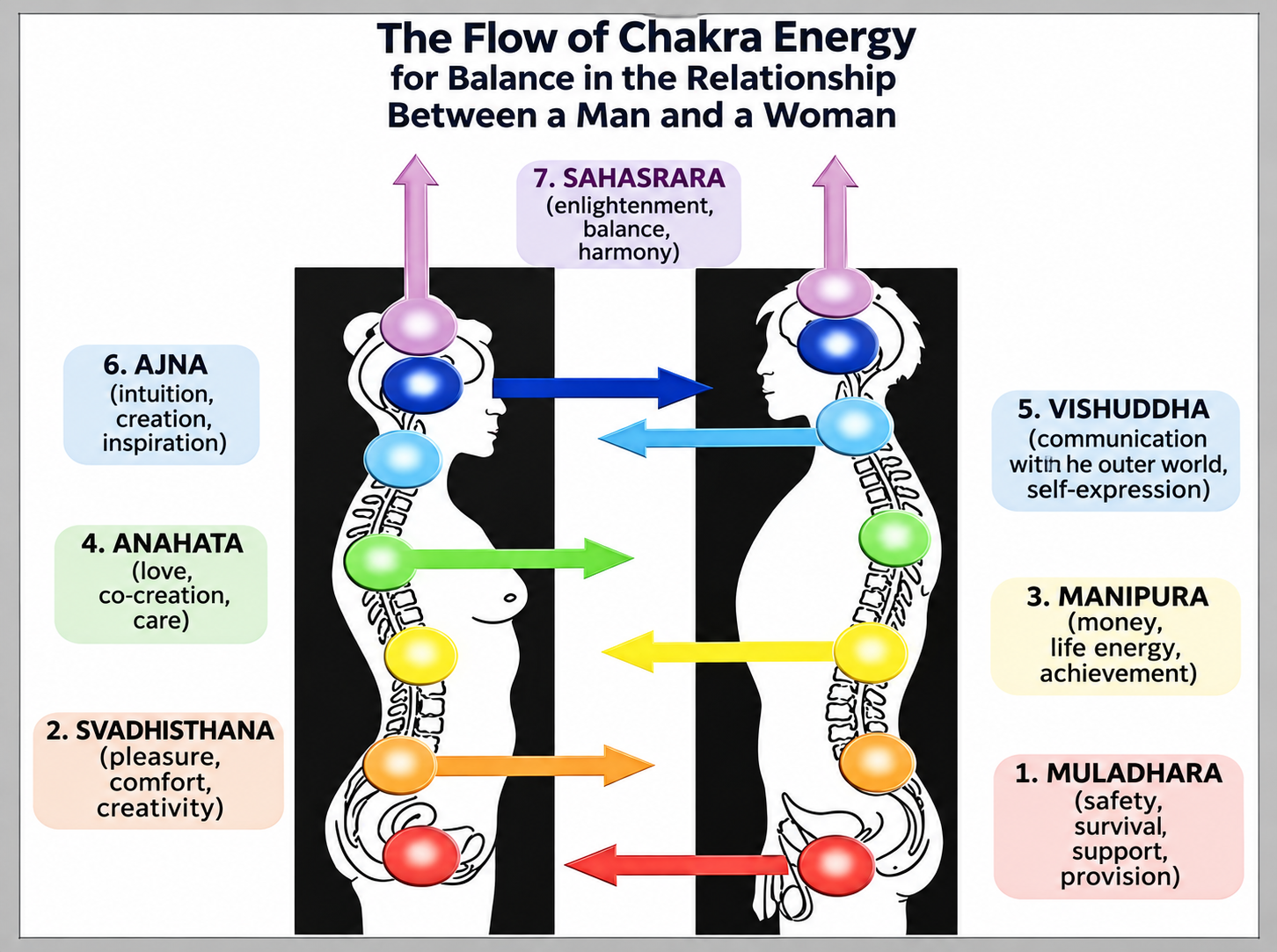
Here is the illustration to visualize this archetypal model of exchange between masculine and feminine energies. I see it as a symbolic representation of reciprocity, showing how different qualities of human consciousness can nourish and complement one another.
What a man brings into a woman's life
In this model, the masculine principle brings grounding, direction, structure, protection, clarity, stability, and the ability to translate intention into physical reality. Yep, he gives the sparks! These qualities become particularly meaningful when embodied through the archetype of the King. A mature King possesses authority over his own life. He understands his desires, makes conscious decisions, takes responsibility for their consequences, and possesses the courage to act in accordance with HIS truth. His strength gives the people around him room to breathe, develop, create, and live. His word has substance because his actions consistently give it substance.
When a man brings his King into a woman's life, he offers her something tangible. He contributes to the practical foundations of their shared existence, including material well-being, physical safety, stability, and the creation of an environment in which she can flourish. He considers her needs when making decisions. He offers his time, attention, resources, protection, and the certainty of knowing where she stands in his life.
For an independent woman, receiving this kind of support can be an extraordinarily intimate experience. She may already possess everything necessary to sustain her existence. She may have spent decades building her own financial security, solving her own problems, protecting herself, and taking responsibility for everyone around her. What a mature man offers such a woman is the experience of being able to share the weight of existence with another human being. She can finally experience partnership in the practical reality of everyday life.
Notice the distinction here. He genuinely wants to do these things for her. He takes pleasure in contributing to her well-being, making her life easier, and creating an environment in which she can flourish. His generosity comes naturally from his affection for her, rather than from a sense of obligation, guilt, or fear of disappointing her. AND! She does not have to demand his support, negotiate for his attention, or repeatedly remind him of her needs and his duties. She can finally relax, knowing that she is no longer the only person responsible for holding everything together. She can remain fully independent and capable while experiencing the extraordinary pleasure of having someone who genuinely wants to take care of her.
Imagine how much energy becomes available to a woman when she no longer has to carry the entire weight of her existence alone. Not that she will stop working all of a sudden and becomes a burden... Energy that can now flow into her creativity, sensuality, tenderness, joy, and love. And imagine how much of that richness becomes available to the man who has helped create the conditions for her to flourish. There is an enormous difference between a man who fulfills his obligations toward a woman and a man who takes genuine pleasure in making her happy. A woman can feel that difference in every dimension of her being.
Material generosity, in this context, is an expression of care made visible. It communicates that her well-being matters to him beyond the moments in which he personally benefits from her presence. He is willing to invest something of himself in the quality of her life, just as she invests something of herself in his. His contribution creates a foundation upon which a much deeper exchange can develop.
What a woman brings into a man's life
What flows from the feminine principle toward the masculine is equally powerful, although its value is often more difficult to measure in material terms. It includes love, tenderness, sensuality, emotional depth, inspiration, creativity, intuitive understanding, and the extraordinary ability to awaken a man's relationship with life itself. In one word, she gives him PLEASURE. And he feels it throughout his entire being. Pleasure is an extraordinarily powerful experience for a man, and its meaning extends far beyond sexual gratification. It is the pleasure of being desired, admired, understood, intellectually stimulated, emotionally touched, and genuinely appreciated. It is the pleasure of discovering new dimensions of himself through his interaction with a woman. It is the pleasure of laughing, exploring, creating, dreaming, and experiencing life with someone whose presence awakens his own appetite for living.
A man may spend decades achieving, building, providing, solving problems, fulfilling responsibilities, and meeting the expectations of others. He may become exceptionally successful at managing his existence while gradually forgetting how much pleasure there is in simply being alive.
A mature woman's love can reawaken that experience. Through her sensuality, curiosity, tenderness, playfulness, intelligence, and emotional depth, she invites him to experience dimensions of life that professional achievements, financial security, and social recognition alone cannot provide.
And here, too, notice the distinction. She genuinely wants to give him pleasure. She takes pleasure in his pleasure. His happiness brings her joy. His intellectual discoveries fascinate her. His physical enjoyment awakens her own sensuality. His emotional openness invites her tenderness. There is something extraordinarily beautiful about this exchange when both people give freely, from the abundance of their own nature. He takes pleasure in creating the conditions in which she can flourish, and she takes pleasure in sharing the richness of her existence with him. Maybe one of the greatest gifts a woman can offer a man is the experience of falling in love with life itself.
A mature Queen possesses sovereignty over her inner world. She understands her own value, recognizes her desires, accepts the complexity of her nature, and possesses the freedom to love without abandoning herself. Her sensuality belongs to her. Her creativity belongs to her. Her capacity to experience joy, pleasure, tenderness, passion, and wonder originates within her own existence. When she opens these dimensions of herself to a man, he receives access to an extraordinary richness of human experience. Her presence can awaken his curiosity, imagination, sexuality, emotional intelligence, intellectual vitality, and desire to explore life beyond the boundaries of his familiar identity.
Through her pleasure of life, a man may discover aspects of himself that have remained dormant throughout decades of achievement, responsibility, and social success. He may rediscover his capacity for tenderness, playfulness, vulnerability, wonder, and genuine excitement about being alive. He may begin to question beliefs that have governed his existence, recognize desires he has spent years suppressing, and encounter dimensions of his humanity that have had very little opportunity to express themselves. She can inspire him to discover the King within himself, while the actual work of becoming that King remains his responsibility.
Understanding the direction of the exchange
One of the most important aspects of this archetypal model, in my understanding, is the sequence in which this exchange reaches its mature form. The man brings his King into the relationship first. He establishes clarity, creates stability, honors his word, takes responsibility for his choices, and contributes to the material conditions of the woman's well-being. Through his consistent actions, he creates an environment in which she can gradually relinquish the need to protect herself from uncertainty within the relationship.
Only then can he receive the fullness of what the Queen has to offer. Her love may already exist. Her attraction, tenderness, generosity, and emotional openness may have been present from the very beginning. Yet the fullest expression of her love requires a relationship capable of receiving and sustaining it. When she experiences consistency, practical care, emotional safety, and a genuine place in his life, MORE AND MORE of her energy becomes available for love, creativity, pleasure, and shared growth. Love cannot be purchased, demanded, or guaranteed through material contributions. A man's generosity creates conditions in which love can unfold freely. Her response remains her own sovereign choice.
I believe this distinction is essential. A woman may give a man her love long before he has demonstrated his capacity to receive it responsibly. She may allow him into the most intimate dimensions of her existence while he continues offering her promises, occasional attention, and an indefinite possibility of a shared future. He may experience the extraordinary richness of her feminine essence while remaining unwilling to create a real place for her within his life.
For a while, he receives the gifts of the Queen without having fully embodied his King. Eventually, the imbalance becomes impossible to ignore.
When a woman is looking for her father in a man
There is another dimension of this exchange that deserves considerable attention: the unconscious psychological wounds that both men and women bring into their relationships. A woman who grew up experiencing emotional neglect, abandonment, rejection, or an absence of paternal affection may carry an enduring hunger for the security and recognition she needed from her father. Unless this wound becomes conscious, her adult relationships may gradually become organized around the attempt to satisfy a childhood need.
She may seek reassurance through financial security, exclusivity, constant attention, social recognition, or the guarantee that a man will never leave her. His presence becomes associated with her own sense of safety and personal value. His independence may feel threatening, and his desire for something beyond the relationship may awaken a much older fear of abandonment. She will constantly remind him of his obligations, using threat, shame and fear. A man can spend decades providing for such a woman, demonstrating loyalty, sacrificing his own desires, and attempting to reassure her. Yet the original wound belongs to an earlier chapter of her life. No amount of material security, marital commitment, or personal sacrifice can retroactively give a woman the childhood she needed. She may receive everything a man is capable of providing and still feel that something essential is missing. He may gradually discover that much of his energy is being directed toward managing a fear whose origins have very little to do with him.
Healing requires her own conscious participation. His love can support that process, but the psychological work remains hers. Otherwise, a relationship between two adults can gradually become organized around the unconscious dynamics of a father and a frightened daughter. The man may remain indispensable to the woman's sense of security while receiving increasingly little of the intimacy, curiosity, sensuality, and freedom he longs to experience with an adult partner. And I wonder what happens to his own emotional needs when so much of his life becomes devoted to protecting another human being from her unresolved past.
When a woman gives her love before the man has brought his King
I know what it means to love a man deeply, to see the extraordinary potential within him, to believe in his words and promises, and to accept fragments of his time and attention while continuing to offer him the fullness of my emotional presence. I know what it means to trust the possibility of a shared future even when his actions repeatedly fail to give that future a tangible form. I have known the pain of discovering that I had been deceived by someone to whom I had opened some of the most intimate dimensions of my existence, not from his evil side of course, but from his afraid boy... I also know that the experience of love I offered him was genuine, regardless of what he was ultimately capable of offering me in return. That distinction has become extremely important to me. The fact that someone failed to honor my love does not diminish the quality of what I gave. My tenderness was real. My intellectual curiosity was real. My sensuality, affection, generosity, vulnerability, and desire to explore the mysteries of life together were real. I believe that through our connection, he was able to experience dimensions of intimacy that extended far beyond sexual pleasure. There was space for intellectual discovery, emotional openness, physical tenderness, spiritual exploration, laughter, vulnerability, and the freedom to question the very foundations of one's existence. I brought my love into his life, and I know the depth from which that love came.
Yet I had made a fundamental mistake in my understanding of reciprocity. I had accepted promises in place of reality. I had accepted occasional attention in place of genuine presence. I had invested in the King I saw within a man whose actual choices had yet to demonstrate his willingness to embody that King in his relationship with me. I had given him something that already existed within me, while continuing to wait for something that existed primarily as a possibility within him. And this is where a woman must eventually return to her own sovereignty. Her ability to love can be extraordinary, but her love cannot perform another person's work of becoming conscious, courageous, honest, and responsible. A Queen must recognize the difference between the King she sees within a man and the man who is actually standing before her.
The difference between being needed and being loved
I increasingly believe that many people confuse the experience of being needed with the experience of being loved. Being needed can give a person a powerful sense of purpose, importance, identity, and moral significance. Someone depends on you. Someone requires your protection, your financial support, your presence, your reassurance, and your continued participation in their life.
Being loved introduces an entirely different dimension of human experience. Another human being takes genuine pleasure in your existence. Your thoughts fascinate them. Your happiness matters to them. Your freedom has value. They are curious about the person you are becoming, and they want to experience life alongside you. They may be perfectly capable of living without you and still consciously choose to welcome you into their world.
For a man who has spent much of his life being needed, encountering this quality of love can be profoundly transformative. He may discover what it feels like when a woman desires his presence beyond his usefulness, when she is interested in his consciousness beyond his responsibilities, and when her affection originates in her enjoyment of who he is. Yet receiving that kind of love also brings a responsibility. A woman who freely opens her world to a man deserves honesty, reciprocity, practical consideration, and the dignity of knowing the actual nature of the relationship she is participating in. The maturity of the King becomes visible in how he treats the woman whose love he has received.
When the King and the Queen finally meet
In its mature expression, the exchange between the King and the Queen creates a continuous movement between the material and the immaterial dimensions of life. He brings his capacity to manifest, protect, build, sustain, and create stability. She brings her capacity to love, inspire, nurture, illuminate, "help" him with her intuition and awaken new dimensions of existence. Both are capable of giving and receiving these qualities, while finding their own authentic expression of masculine and feminine complementarity.
His love becomes visible through the reality he helps create for her. Her love becomes visible through the richness of life she chooses to share with him. His actions give her reasons to trust. Her presence gives him opportunities to discover life beyond achievement, obligation, and survival. Neither childhood wounds nor unfulfilled promises can sustain this exchange indefinitely. It requires two adults who are willing to encounter each other as they actually are and assume responsibility for what they bring into the relationship. A marriage certificate can establish a legal relationship. The meeting of the King and the Queen requires a quality of consciousness that no institution can confer. And when a man HAS experienced the love of a woman who has opened her intellect, her heart, her body, her intuition, her imagination, and her consciousness to him, I wonder whether he can ever genuinely forget what that experience revealed about his own capacity to be alive.
More importantly, what is he willing to bring into reality in response to the love he has received?
The loneliness of being touched without being felt
There is a particular kind of loneliness that can exist within a marriage, within a shared bed, and even within an active sexual relationship. It is the loneliness of being touched without being felt, listened to without being understood, desired without being truly known. A woman may have a husband who touches her regularly, who desires her sexually, who provides for the family and fulfills his responsibilities. Yet she may still experience an almost unbearable loneliness in his presence. She may struggle to explain why his affection feels insufficient, why his sexual advances sometimes leave her feeling even more isolated, or why she has gradually lost the desire to open herself to him. From his perspective, he may be doing everything a loving husband is supposed to do. From hers, something essential has been absent for years. And of course the same truth will be for a man feeling lonely in his own marriage. But it is easier for me to talk from a female side... What she may be longing for is the experience of being perceived in her entirety. She wants someone to be curious about the way her mind works, the things that frighten her, the questions she carries, the contradictions within her personality, the desires she has never dared to articulate, and the woman she is continuously becoming. She wants to be interesting to him even when she is fully dressed, when she is exhausted, when she is absorbed in something that has absolutely nothing to do with him, when she is angry, confused, intellectually challenging, or simply sitting in silence.
And men carry this longing too. A man may spend decades being appreciated for his ability to provide, protect, solve problems, maintain stability, and satisfy the expectations of others, while secretly wondering whether anyone is genuinely interested in the human being beneath all those functions. He may have a perfectly respectable marriage, a family, financial security, an established social identity, and a sexual relationship that satisfies his physiological needs. Yet enormous dimensions of his personality may remain unexplored, unexpressed, and untouched. Who is interested in the questions that keep him awake at night? Who challenges his understanding of the world? With whom can he explore the contradictions within his own consciousness? Where can he express his tenderness, his wildness, his uncertainty, his intellectual hunger, his unconventional desires, and the parts of himself that have never quite fitted into the identity he has constructed?
A person can gradually become accustomed to living within a relationship that accommodates only a limited portion of who they are. Over time, they may even begin to believe that the remaining parts of themselves are unnecessary, inappropriate, immature, selfish, or dangerous. They learn to suppress certain desires, abandon certain conversations, and stop expecting certain forms of connection. Eventually, they may call this adjustment maturity, acceptance, commitment, or the natural evolution of a long-term relationship. Then something unexpected happens. They encounter another human being in whose presence those dormant parts of themselves begin to come alive. Suddenly, they remember what it feels like to be intellectually excited by another person. They discover conversations they do not want to end. They experience tenderness that awakens something far deeper than sexual appetite. They find themselves laughing differently, thinking differently, questioning things they had accepted for decades, and becoming curious about their own existence again. Their emotional, intellectual, physical, and spiritual dimensions begin to participate in the same relationship. The encounter reveals how much of their humanity has remained unexpressed.
And once you have experienced that depth of intimacy, how do you return to a life in which so many parts of you remain untouched? How much of yourself must you silence to convince yourself that what you already have is enough?
The erotic nature of intellectual intimacy
I believe intellectual intimacy is one of the most underestimated dimensions of human sexuality. There is something profoundly erotic about encountering a consciousness that awakens your curiosity, challenges your perception, expands your understanding, and introduces you to dimensions of yourself that you had never previously encountered. A conversation can remain alive within you for days. A question can continue unfolding for years. The way another person thinks can become as attractive as the way they look, and the experience of discovering their mind can generate a form of excitement that extends far beyond physical attraction.
Imagine being able to discuss your deepest philosophical questions with the same person with whom you experience extraordinary sexual pleasure. Imagine being able to move naturally from a conversation about consciousness, death, human nature, or the mysteries of existence into laughter, tenderness, playfulness, and physical desire. Imagine being able to bring your intellectual complexity into a relationship without having to simplify yourself to remain acceptable or understood. For some people, this dimension of intimacy is essential. They need to experience the excitement of another person's consciousness. They need to be challenged, surprised, inspired, and occasionally confronted. Their attraction is intimately connected to the experience of discovering something new within another human being and, through that discovery, within themselves.
When intellectual intimacy, emotional openness, physical attraction, and spiritual curiosity coexist, sexuality acquires an entirely different quality. The body becomes another language through which an already existing connection expresses itself. And sometimes the most erotic thing that happens between two people takes place while they are fully dressed, sitting across from each other, talking.
Can we feel what another person is hiding?
One of the most interesting aspects of my own sensitivity is the physical experience of incongruence. When a person's words, emotional state, intentions, and actions exist on different levels, I can sometimes experience that discrepancy within my own body before my mind is able to formulate what is happening. It is a peculiar experience because the conscious mind can be listening to a perfectly reasonable explanation while the body is registering something entirely different.
Human beings are extraordinarily skilled at constructing explanations for their behavior. We can justify almost anything through circumstances, moral obligations, religious beliefs, social expectations, previous experiences, or our responsibilities toward other people. We can convince ourselves that we are acting out of love while being driven by fear. We can persuade ourselves that we are exercising self-control while suppressing an essential part of our humanity. We can call our emotional withdrawal maturity, our inability to make a decision patience, and our fear of vulnerability wisdom. The mind is capable of sustaining these contradictions for decades. The body participates in them, carrying the tension, the suppression, the longing, and the continuous effort required to maintain the internal division.
Now imagine bringing all of that into sexual intimacy. A person may experience genuine love and simultaneously be terrified of its consequences. He may desire a woman intensely while resisting the emotional transformation that loving her would require. She may long to surrender to the experience while remaining painfully aware of his internal resistance. Both can experience pleasure, tenderness, and profound attraction while carrying conflicting intentions and fears. What is being communicated in such an encounter? How much of the other person's internal conflict becomes part of our own experience? What happens when we repeatedly open ourselves to someone whose internal world is characterized by suppression, fear, guilt, or dishonesty? And how does our experience change when we encounter someone whose words, feelings, intentions, and actions are increasingly aligned?
These questions have become particularly important to me as my own sensitivity has developed. I have become much more attentive to the quality of the interactions I allow into my life and to the way my body responds to the presence of different people. I am also increasingly aware of the responsibility I carry for what I bring into the lives of others. If my body can respond so intensely to another person's emotional state, I must also consider the effect that my own internal state may have on the people who open themselves to me. Intimacy makes this responsibility especially significant. It requires us to become aware of what we are carrying within ourselves before we bring it into the most vulnerable spaces of another person's life.
Fidelity of the body and fidelity of attention
We have spent centuries discussing sexual fidelity as one of the primary measures of a person's commitment to a relationship. Yet I wonder how often we examine the fidelity of our attention, our curiosity, our emotional presence, and our willingness to continue discovering the person we have chosen to share our life with.
A person can remain sexually faithful for forty years while gradually withdrawing every other dimension of intimacy from the relationship. He can give his intellectual excitement to his colleagues, his curiosity to strangers, his emotional energy to his work, his enthusiasm to his hobbies, and the best hours of his day to his ambitions. His partner receives whatever remains of him in the evening. She may do precisely the same thing. Both can consider themselves exceptionally faithful while experiencing an increasingly impoverished relationship.
I find it interesting that we can be so concerned about where our partner's body goes while paying remarkably little attention to where their consciousness goes. Where does their curiosity naturally lead them? With whom do they share their most exciting discoveries? Whose thoughts do they want to hear? In whose presence do they become more playful, more intellectually alive, more emotionally open, and more interested in life itself?
Of course, love cannot require exclusive ownership of another person's consciousness. We need friendships, intellectual communities, independent interests, and experiences that exist outside our romantic relationships. But the gradual disappearance of curiosity between two people deserves far more attention than we generally give it. There is something profoundly intimate about giving another human being your undivided attention. Listening to them without preparing your response, without searching for an opportunity to correct them, without looking for a solution to their problem, and without becoming uncomfortable simply because their experience challenges your own understanding of the world. Allowing someone to finish a thought that they themselves are still trying to formulate requires a certain generosity of consciousness.
The same applies to touch. A hand resting on another person's body can communicate an extraordinary range of intentions. It can express desire, affection, reassurance, possession, impatience, entitlement, curiosity, or the expectation that something should happen next. The physical movement may look almost identical from the outside, while the experience of receiving that touch can be entirely different. Can you touch someone simply because you are delighted by their existence? Can you hold a woman without silently expecting the embrace to lead to sex? Can you offer tenderness to a man without requiring him to perform strength, confidence, or competence in return? Can you remain present with another person's vulnerability without trying to change their emotional state simply because it makes you uncomfortable?
These are the ordinary, daily expressions of intimacy that I find increasingly meaningful. They reveal the extent to which we are genuinely available to another human being. And when two people stop being curious about each other, I wonder how much of their relationship continues to exist through habit, familiarity, shared history, and the identities they have built around one another.
The erotic nature of emotional safety
Emotional safety is often discussed in language that makes it sound comfortable, predictable, and somewhat incompatible with passion. I experience it as something considerably more complex. Genuine emotional safety gives a person the freedom to reveal aspects of themselves that are usually protected, including their wildness, intensity, sexuality, anger, imagination, tenderness, and unconventional desires. It creates room for the full spectrum of human experience.
Imagine the difference between a woman who is constantly monitoring herself in the presence of a man and a woman who feels free to inhabit her entire being. The first is paying attention to how she looks, whether she is desirable enough, whether her responses are appropriate, whether her emotions are excessive, whether her desires might frighten him, and whether revealing too much of herself could eventually cost her the relationship. An enormous amount of her energy is occupied with managing the experience of being perceived.
The second woman has access to all that energy. She can laugh, experiment, express desire, refuse something she does not want, initiate something she does want, reveal her fantasies, and experience pleasure without continuously evaluating herself through another person's eyes. She can be extraordinarily tender and extraordinarily wild within the same relationship. Her freedom becomes part of her sexuality.
The same freedom can be transformative for a man. Imagine being able to experience sexuality without the continuous pressure to perform, impress, dominate, satisfy, prove your masculinity, or demonstrate your competence. Imagine being able to reveal tenderness without fearing that it will diminish your attractiveness, to acknowledge uncertainty without feeling inadequate, and to receive affection without first having to earn it through achievement. Imagine being able to reveal the parts of yourself that contradict the image of the man you have spent your entire life trying to become, and discovering that another human being can still look at you with tenderness, desire, curiosity, and respect.
How much of our sexual energy is consumed by the effort of maintaining an identity? And what becomes available to two people when they gradually relinquish that effort in each other's presence?
I think this is where sexuality becomes particularly interesting. Two people begin discovering what their bodies and consciousness are capable of experiencing when their energy is no longer entirely occupied with self-protection. There is something profoundly erotic about the freedom to be fully human in the presence of another human being.
The sacred dimension of sexuality
When I speak about the sacred dimension of sexuality, I am referring to something that has become increasingly tangible in my own understanding of human interaction. I do not require elaborate ceremonies, religious authorization, special techniques, or spiritual terminology to recognize the extraordinary nature of what can happen between two human beings.
Consider the simple fact that consciousness, whatever its ultimate nature may be, experiences the world through the extraordinary biological structure of the human body. Through this body we can perceive another human being, experience pleasure, communicate affection, create life, encounter vulnerability, and participate in processes that can profoundly transform our understanding of ourselves.
Sexuality brings many of these dimensions together in a single experience. It involves our most ancient biological impulses, our capacity for pleasure, our emotional history, our psychological defenses, our imagination, our ability to trust, and our relationship with our own consciousness. It can expose the places within us where we are still governed by fear, shame, control, and the need for validation. It can also reveal an extraordinary capacity for generosity, tenderness, freedom, and connection.
For me, this makes sexuality one of the most fascinating areas of human spiritual development. Our relationship with sexuality reveals so much about our relationship with life itself. How comfortable are we with pleasure? How much permission do we give ourselves to desire? How frightened are we of losing control? How capable are we of receiving? How much of our behavior is governed by the need to possess, to be chosen, or to secure another person's affection? Can we experience something profoundly beautiful without immediately attempting to control its future?
Sexual intimacy can become an encounter with our own consciousness through the presence of another human being. Another person's touch, attention, honesty, and openness can reveal dimensions of ourselves that have remained inaccessible through years of intellectual self-examination. Equally, another person's withdrawal, dishonesty, fear, or emotional unavailability can illuminate our deepest attachments and unconscious patterns. Sometimes an intimate encounter reveals an entire unlived dimension of our existence. We discover capacities for tenderness, passion, creativity, vulnerability, and joy that we had never previously recognized within ourselves. The experience changes our understanding of what it means to be alive.
This is an extraordinary responsibility to carry when another human being allows us access to their most vulnerable dimensions.
When intimacy becomes inconvenient
We often underestimate how much courage genuine intimacy requires. Physical nakedness is relatively simple compared with the experience of allowing another person to see the full complexity of who we are. To reveal the desires that contradict our carefully constructed identity, the fears that undermine our confidence, the feelings that challenge our moral framework, and the tenderness that makes us vulnerable to loss requires an enormous degree of inner freedom.
And this is where I believe many people reach the limits of their capacity for intimacy. They can experience love, attraction, sexual pleasure, and even extraordinary moments of connection. Yet when that connection begins demanding greater honesty, greater emotional availability, or a reconsideration of the life they have constructed, they retreat into the familiar structures of their identity. They attempt to contain the experience within boundaries that allow them to enjoy its most pleasurable aspects without confronting everything else it has awakened within them.
Genuine intimacy can be profoundly inconvenient. It can challenge our beliefs about ourselves, expose the limitations of our existing relationships, awaken desires we have spent years suppressing, and force us to confront the distance between the life we are living and the life we are capable of living. It can reveal that our understanding of love, freedom, fidelity, responsibility, and even our own sexuality has been shaped by fears we have never consciously examined.
Sometimes a person will spend years returning to a connection that makes them feel alive while simultaneously trying to convince themselves that they could live without it. They may attempt to redefine it, intellectualize it, minimize its significance, or reduce it to sexual attraction. They may persuade themselves that their longing is temporary, that familiarity will eventually become sufficient, or that the parts of themselves awakened through that connection can simply be put back to sleep.
I find this particular human contradiction fascinating. We can become so attached to the preservation of our existing lives that we begin negotiating with our own capacity to experience life. We try to determine how much love we can afford, how much desire is acceptable, how much truth we are willing to acknowledge, and how much of our own humanity we can suppress without disturbing the structures that provide us with security.
There are legitimate responsibilities, complex circumstances, and other human beings whose lives are affected by our decisions. An intense connection alone cannot determine what choices we should make. But whatever we choose, I believe we owe ourselves enough honesty to recognize the price of that choice. Every decision has consequences. Remaining where we are also has consequences. Suppressing a desire, abandoning a possibility, or accepting a limited form of intimacy can have a profound effect on our internal lives, even when nothing changes externally. The question is whether we are conscious of what we are choosing and what we are sacrificing in the process.
We can experience an extraordinary connection with another human being and still lack the courage to live in accordance with what that connection has revealed. We can spend years trying to reduce something profoundly transformative to a manageable arrangement, a sexual encounter, a beautiful memory, or an occasional escape from the responsibilities of everyday life. We can continue returning to the experience for the pleasure it provides while carefully avoiding the transformation it invites. The capacity to experience intimacy and the capacity to live intimately are two very different stages of human development.
How naked are we when we are naked?
The older I become, the more fascinated I am by the possibility of truly encountering another human being. I am interested in the consciousness behind the eyes, the intelligence within the body, the history that has shaped the personality, the contradictions that make someone human, and the potential that exists within each of us. I am interested in what happens when two people remain sufficiently curious about one another to continue discovering each other, even as both of them change.
I want to understand the nature of the connection that can make a conversation feel more intimate than sex, that can make silence between two people feel extraordinarily full, and that can allow a single touch to communicate something for which language seems entirely inadequate. I want to understand the physical, psychological, emotional, and spiritual dimensions of this experience, including those aspects of human perception that we are only beginning to investigate scientifically.
And I increasingly understand why sexuality deserves so much more awareness than we generally give it. Every time we become intimate with another person, we are opening ourselves to an extraordinarily complex living system. We are allowing another human being into our physical, emotional, and psychological space, and we are simultaneously entering theirs. The quality of that encounter depends enormously on what each of us brings into it and on our willingness to perceive, respect, and remain present with what we discover there.
There is something immensely beautiful about two people who have already been intimate throughout the day, through their conversations, their laughter, their intellectual curiosity, their tenderness, their honesty, and the simple pleasure of being in one another's presence, finally allowing that intimacy to express itself through their bodies. Their sexuality becomes a continuation of everything that has been unfolding between them long before they removed their clothes.
I think this is what so many human beings are longing for, often without knowing how to articulate it. To be desired in the fullness of their humanity. To experience the freedom of being completely themselves in the presence of another person. To be intellectually challenged, emotionally understood, physically desired, and spiritually awakened. To be touched with an awareness of everything that lives beneath the skin.
And once we have experienced such intimacy, we may find ourselves facing questions that are far more uncomfortable than anything we have ever encountered in a bedroom. When we lie naked beside another human being, how much of ourselves are we actually allowing them to encounter?
We can spend years learning how to give another person pleasure. We can spend decades sharing a bed with someone. Learning how to encounter another person's consciousness, while having the courage to reveal our own, may well be the work of an entire lifetime.