Ouroboros, the Death of Identity, and the space where a New WAY begins
OUROBOROS · THE CYCLE AND THE OPENING
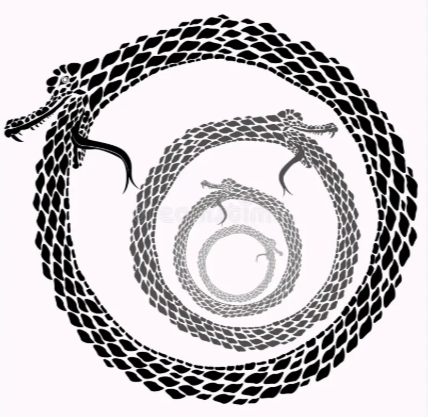
Recently, I came across a text about Ouroboros, the ancient symbol of a serpent holding its own tail in its mouth. It is a fascinating image of something simultaneously consuming and creating itself, where the end becomes the beginning, death gives way to birth, and destruction makes another cycle of creation possible. We usually associate Ouroboros with eternity, the endless movement of life. But there is another, rather uncomfortable dimension to this symbol that caught my attention. The serpent is holding the circle together with its own jaws. It is
actively participating in the cycle that consumes it. And I immediately recognized something profoundly human in this image.I have been observing how people change relationships, jobs, cities, friends, circumstances, and sometimes entire countries, only to discover themselves standing in remarkably familiar situations. A woman leaves one emotionally unavailable man and falls in love with another, convinced that this time everything will be different. A man escapes a workplace where he was constantly undervalued and eventually finds themselves fighting for recognition in the next one. Someone ends a friendship after being betrayed, promises never to tolerate such treatment again, and gradually develops another relationship with exactly the same dynamics. The faces change, the circumstances change, and yet the emotional experience remains painfully recognizable.
At some point, we begin wondering why life keeps presenting us with the same lessons.Freud explored something similar through his concept of repetition compulsion. He observed that people sometimes unconsciously recreate painful experiences rather than simply remembering them. We may return to familiar emotional situations as though we are trying to achieve a different ending to an old story. A child who grew up feeling unworthy of love may become an adult who repeatedly seeks affection from people who cannot offer it freely. If this person finally chooses them, the old wound might somehow be healed. Someone who was constantly criticized may continue entering relationships where they must prove their intelligence, competence, or value. I find this particularly fascinating because familiarity has enormous power over us. We may consciously desire freedom while our learned expectations continue directing us toward what we recognize. Even suffering can become familiar enough that we know exactly how to behave inside it. We know our role, our reactions, our explanations. We know how to be the abandoned one, the misunderstood one, the rescuer, the fighter, the one who always gives more, the one who must earn love.Over time, I have also become interested in the less comfortable aspects of these patterns, especially the ways certain identities offer us something we are reluctant to surrender. I have seen how people can become so attached to the roles they have built their lives around that preserving those roles becomes more important than examining what is actually happening within them. Someone may fight desperately to maintain the familiar structure of a family, the established order of relationships, the position they occupy in another person's life, because without that structure they would have to confront the terrifying question of who they are when the roles no longer define them. Someone else may spend years protecting the identity of a good husband, a devoted father, an honorable man who always does the right thing, even when maintaining that image requires an exhausting negotiation with his own desires, feelings, and contradictions. And then there might be a person who believes they are fighting for love, for truth, for the courage to make an authentic choice, while somewhere underneath that noble struggle lives a much older longing to finally be chosen. Each person has a perfectly understandable explanation for what they are doing.
Each can point to love, loyalty, responsibility, sacrifice, or integrity. And each may be genuinely trying to do their best. Yet the same arrangement continues, sustained by three different fears of losing the identities through which they have learned to recognize themselves. I find it fascinating how an entire relationship system can remain intact through the very struggles that appear to threaten it. Everyone is fighting for something so important to them that it may feel like no one understand you, no one is hearing YOU... and everyone is paying a price, and nobody quite realizes how much of the familiar suffering depends on their own continued participation.
Of course, painful circumstances are not always created by the person experiencing them, and responsibility for another person's cruelty or betrayal belongs to the person committing it. Still, there are situations in which we continue participating in familiar dynamics long after we have recognized how much they cost us. I find it particularly interesting how an experience that once caused enormous suffering can gradually become the very foundation of a person's identity. Someone witnesses a family falling apart, watches a parent struggle with abandonment, poverty, resentment, or disappointment, and makes a silent decision about how life must be lived. Certain choices become unforgivable. Certain roles become sacred. Loyalty becomes inseparable from staying, love becomes inseparable from obligation, and the preservation of a family structure becomes a measure of moral character. Years pass, circumstances change, and life eventually presents another situation involving the same uncomfortable questions of love, freedom, loyalty, and personal choice. But by then, the original pain has become an entire system of beliefs, expectations, and judgments through which every new experience is interpreted. The person may spend enormous energy protecting the very structure that was supposed to guarantee happiness, while living with constant uncertainty about whether that happiness will ever arrive. They may demand stability from someone who cannot provide it, interpret another person's independence as betrayal, or attempt to preserve closeness through obligations that gradually become sources of resentment. Sometimes the unresolved conflict extends into the next generation, where children inherit loyalties, silences, and emotional divisions they never consciously chose. And this is where I return to my reflections on karma and the extraordinary patience of time. The universe never forgets anything. We can refuse to revisit an old experience, refuse to question the conclusions we drew from it, and spend decades building a life designed to protect us from ever feeling that pain again. Yet the underlying question may remain unanswered. In the spiritual language I use to understand these patterns, the karmic lesson is still waiting. And there is a price attached to every desire we insist on fulfilling at any cost. Sometimes we pay for the security we demand with our own peace. Sometimes we pay for the roles we refuse to release with years of emotional exhaustion. Sometimes we preserve the appearance of what we wanted while quietly losing the experience we hoped it would give us.
I have begun asking myself what I am still receiving from being a particular version of myself, what I have already sacrificed to maintain that identity, and whether I am finally ready to live without the role that has organized so much of my experience.
Recognizing a pattern and giving up the identity that sustains it are two entirely different things. We can spend years studying psychology, exploring childhood experiences, working with therapists, attending retreats, meditating, examining karma, and identifying unconscious mechanisms. We can explain our patterns beautifully and even teach other people about them. Then life presents us with a familiar situation, and we discover whether anything has actually changed. We find out through our actions, through the moments when we no longer return to the person whose behavior has repeatedly hurt us, no longer explain ourselves to someone determined to misunderstand us, no longer rescue someone who has no intention of changing, or finally manage to say no without offering an elaborate defense of our right to do so. The old identity survives through the actions that continue supporting it, and each time we repeat those actions, we give the familiar story another opportunity to continue.
This is where the symbolism of Ouroboros becomes especially interesting to me. The serpent has to open its mouth. And when it does, the circle breaks, leaving a space where the familiar pattern used to exist. I have experienced this strange territory myself, when an old identity has lost its authority and nothing has arrived to replace it. All of a sudden, I do not feel like I want to behave as I once did, but I do not yet know how life will unfold without those familiar reactions. The arguments have stopped, the explanations have become unnecessary, the emotional negotiations have ended, and suddenly there is an enormous amount of space where something used to happen. It can be surprisingly uncomfortable to discover how much of our identity was organized around a particular struggle.
We are so accustomed to filling our lives with activity, meaning, relationships, plans, problems, expectations, and emotional negotiations that we barely know what to do when nothing is happening. We immediately look for the next project, the next person, the next spiritual practice, the next explanation, the next identity. We want to know who we are becoming before we have fully allowed ourselves to stop being who we were. And this is precisely where another teaching I have been studying recently became extraordinarily relevant.
My teacher of Sacred Knowledge gave a lecture about Ether, or Akasha, the fifth element in the traditional system of five elements. She described it as the fifth that is also the first and the last, the element that contains all the others and from which everything emerges. She began with a story about the five Shiva temples in Tamil Nadu, India, each associated with one of the five elements: earth, water, fire, air, and ether. At Chidambaram, the mystery of ether is traditionally represented through the sacred space concealed behind a curtain. The teaching directs our attention toward emptiness itself. I find this image extraordinary because we spend so much of our lives searching for something tangible, something we can possess, understand, recognize, or identify, while here the mystery is approached through the absence of an object.
My teacher described ether as the space between inhalation and exhalation, that brief pause when one movement has ended and the next has not yet begun. It is the space that contains everything while having no fixed form of its own. She used the example of a vessel to explain its significance. We can admire the vessel's shape, material, color, craftsmanship, and decoration, but its usefulness depends on the empty space inside it. Without that space, it cannot receive anything. I kept thinking about how much attention we devote to the external forms of our lives, our identities, homes, relationships, professions, possessions, accomplishments, responsibilities, and beliefs, while rarely considering whether there is any space left within them. And why do we ALWAYS want to fill the emptiness with something? whether it is a physical object, a thought, or a meaning....
The serpent has to open its mouth.
She spoke about the body in the same way, inviting us to consider the cavities and passages that make movement and function possible for us to live and move. She used the womb as a particularly powerful image of space capable of receiving and carrying new life. Then she brought the subject into something wonderfully ordinary and practical, asking us to examine the spaces we occupy. Our homes, our rooms, our belongings, even our phones, our thoughts... Is there room to take another photograph, write another note, create something new, or have we filled every available space? I smiled when I heard that part because it is such a simple way to approach something we tend to make terribly mystical. We can speak endlessly about consciousness, divine creation, and the mysteries of the universe while having absolutely no room in our calendars, homes, minds, or lives for anything unexpected to happen. No room for miracle! Life HAD to follow our opinion, our understanding of how it SHOULD be...
The most important part of the lecture, for me, was her understanding of what this empty space represents. She described it as the space we leave for God, the part of our lives we do not attempt to control, calculate, organize, decorate, or fill with another practice, another ritual, another intention, or another demand. She spoke about how our desire to fill everything can arise from anxiety, fear, the need to impress, the desire to be liked, and the compulsion to make something happen. We keep adding more, doing more, preparing more, trying to make the experience extraordinary, while leaving very little room for anything to unfold beyond our expectations.
This touched something very deep in me because I have spent much of my life being exceptionally capable of making things happen. I know how to organize, solve problems, take responsibility, rescue others, pursue what matters, and continue moving when circumstances become difficult. I have used these abilities professionally and personally, and they have served me well. I also recognize how easily determination can become control, how love can become an endless attempt to find the right solution for another person's problems, how spiritual development can become another project to manage, and how even surrender can become something we try to accomplish correctly. I am learning to leave certain things unfinished and undefined, to allow an ending to exist without immediately demanding that it reveal its purpose, and to recognize that the pause between breaths has its own place in the movement of life. My element is Ether anyway. My name is Ara Tara - the core, the center that combines impossible possibilities into possible embodied life.
When the serpent releases its tail, the circle opens and the old pattern is interrupted. But an open circle offers none of the familiar protection of a completed story. We have to tolerate the uncertainty of what comes next. I have been thinking about how often we describe transformation as becoming someone new, imagining a better version of ourselves, a wiser person, a more successful person, a spiritually evolved person. We create another identity and begin moving toward it, sometimes before we have even stopped maintaining the old one. I am increasingly interested in the possibility of allowing the space to remain open long enough for something genuinely different to emerge.
· · ·
I have been exploring this in relation to karma. In the spiritual language through which I understand my own experiences, karma is connected to the consequences of our choices and the lessons we continue encountering until we become capable of responding differently. Certain patterns in my life have returned with such remarkable precision that I have had to examine my own participation in them. And I have discovered that one of the most difficult parts of completing a cycle is the period when we have finally stopped repeating the old behavior, but the new life has not yet taken shape. We want evidence that we made the right decision. We want a reward, a sign, a new relationship, a NEW opportunity, some immediate confirmation that our suffering was worthwhile. We want the empty space filled with proof that the ending had a purpose.
My teacher's lecture brought me back to something I had experienced personally during our Mysteries of Ether at Angkor Wat in Cambodia. We explored the purity of ether through the symbolism of the temple itself, particularly its central sanctuary on the third level, surrounded by four wells representing the other elements. The entire space carried the meaning of unity: solar and lunar energies, masculine and feminine, light and darkness, all meeting in the fifth element that contains them. We had also explored these meanings at Bayon, but what happened at Angkor Wat remains one of the most extraordinary experiences of my life. On the day of the equinox, our group found itself completely alone in the central sanctuary, something almost unheard of in a place usually filled with visitors and guards. And then, as we were moving through the mystery, an enormous hornbill appeared on the central tower. Our guide, who had worked there for fourteen years, told us she had never seen one sitting in that particular place. Shortly afterward, a woman-shaman arrived unexpectedly and told us she had been guided there to thank us for what we were doing. She had no prior knowledge of our group or our ceremony. And just as we completed the mystery, the sky opened and an extraordinary downpour began. I remember the amazement of witnessing these events unfold one after another, without any of us having planned or arranged them. My teacher spoke about leaving space for God, about allowing the mystery to reveal itself without trying to control its form, and there we were, experiencing something none of us could have scripted. I still remember the feeling of being completely present in that sacred space, watching life unfold in ways I could never have anticipated.
What I continue carrying inside of me me is the relationship between openness and control, and how much of our lives we spend trying to determine what must happen next. We can prepare a space, enter it with intention, bring our attention and awareness to what is happening, and still leave the outcome undetermined. That experience at Angkor Wat, together with my teacher's reflections on the purity of ether, has made me examine the purity of my own inner space. I have begun paying closer attention to what fills my mind when I wake up, which conversations continue long after they have ended, which old arguments I continue rehearsing, what identity I continue to protect, and how much room I give to resentment, anticipation, comparison, judgment, fear of the result in the future, and the endless desire to understand why someone behaved as they did. I have also become increasingly aware of how much of our inner world can remain occupied by people and situations that are no longer physically present in our lives. We can spend years carrying these invisible conversations, defending ourselves against accusations nobody is making anymore, preparing answers to questions nobody has asked, and maintaining emotional relationships with versions of people who may no longer even exist. And all of this occupies space. The very space in which something new could be born. I keep returning to the question my teacher asked us to consider: how much of my own inner space am I willing to leave empty, without immediately filling it with another thought, another expectation, another explanation, or another attempt to control what happens next?
The space we leave for God.
I have been exploring the subject of identity for some time now. Recently, during an inner experience, I began removing the different masks through which I have known myself. The professional, the mother, the wife, the lover, the healer, the woman who understands, the woman who fights, the woman who loves. I wanted to discover who I was underneath all of them. What is that true self inside? And when I reached the place where I expected to find my true identity, there was nothing I could define... I smiled... It was such a surprising discovery because I had spent years trying to understand who I really was, and suddenly I could see that I did not have to remain attached to any single description. I could experience all these roles without requiring one of them to become the permanent definition of my existence.
Today, this experience makes even more sense to me. I have begun thinking about the purity of identity as our willingness to stop accumulating definitions of ourselves. We become attached to being the one who was abandoned, the one who always has to fight, the one who never receives enough, the one who must save everyone, the one who knows the truth, the one who has suffered, the who who is never chosen, or even the one who has awakened. Each of these identities can become another form we are afraid to lose. And once we begin protecting it, we may find ourselves feeding the same circle again, arranging our experiences around the need to remain recognizable to ourselves.
The purity of thought has begun to acquire a similar meaning for me. I do not imagine a mind permanently free of difficult thoughts. Thoughts arise, memories return, and fear, jealousy, anger, longing, and judgment are part of human experience. I am interested in recognizing these movements without giving every one of them a permanent home. I can feel anger without building an identity around being wronged, experience longing without turning it into a command to pursue, and recognize fear without allowing it to design my future. I can also leave a thought unfinished, without following it through every possible argument, explanation, and imagined outcome. There is an extraordinary amount of freedom in discovering that I do not have to participate in every story my mind offers me.
Ether is also connected with sound. We recognize the character of a space through its acoustics, through the way sound changes according to the space in which it moves. And I wonder, have you ever been with someone who allowed you to experience ALL of yourself? Someone with whom you could be everything you are, without shame, without hiding, without having to choose which parts of yourself were acceptable? Someone who awakened your passion, tenderness, courage, creativity, desire, and parts of your soul you had never fully expressed before? And if you have experienced that kind of freedom, how do you live without it afterward? How do you forget what it felt like to be completely yourself? Can you really return to a life in which you must silence those parts of yourself again, knowing exactly what it feels like when they are alive? And what happens to your soul when you have heard its full expression, but choose to live where only part of it can be heard? Mmm? Ether allowed you to be whole...
Ether is associated with voice, vibration, and the capacity to transmit information. It is connected to the throat, the womb, and the crown, a continuous passage where emptiness allows for manifestation. This detail is especially meaningful to me because of something I experienced recently at my younger daughter's concert. For approximately fifteen minutes, I had the extraordinary sensation that there was no separate person sitting in the audience listening to music. I felt as though I had become the music itself. Every part of my body seemed to vibrate with the sound, and the familiar boundary between myself, the music, and the concert hall seemed to disappear. I was the music, I was the hall, and there was simply an experience unfolding without the usual sense of a separate person standing in the middle of it.
I still do not know how to explain that experience completely, but when my teacher spoke about ether, sound, and space, I immediately remembered it. There had been no effort to become anything, no identity to maintain, no experience to produce. For those minutes, I was simply present, and the ordinary boundaries through which I usually perceive myself had become strangely fluid. It made me think about the space between death and birth in an entirely different way. We are so accustomed to organizing every experience around the question of who we are that we rarely allow ourselves to experience life without immediately assigning it a meaning about our identity.
The image of the pause between inhalation and exhalation keeps me paused here. We breathe in, receive, experience, and breathe out, release, and allow the next movement to come. Between these movements there is a brief natural stillness. We cannot remain indefinitely in that pause because life continues moving, but we also do not need to eliminate it. I have noticed how often we attempt to eliminate similar pauses in our lives. We finish one relationship and immediately begin another, leave one identity and quickly adopt a new one, complete one project and fill the next available hour with another obligation. We experience an ending and immediately demand a beginning because the space between them leaves us without a familiar role to perform.
· · ·
I am beginning to recognize how much of our suffering can occupy this space. The old cycle gives us something to do, something to think about, someone to blame, someone to rescue, something to prove, and an identity to maintain. When we finally stop participating in it, we may discover that we have no idea what to do with the freedom that remains. I am learning to resist the urge to fill it immediately, to examine what occupies my physical surroundings, my emotional life, my thoughts, my relationships, and my expectations. I want to recognize the difference between something that genuinely nourishes me and something I maintain simply because I have maintained it for years.
I love the paradox of ether. It is described as both everything and nothing, the first element and the fifth, the space from which forms arise and into which they eventually disappear. It is connected to the Greek idea of the upper air breathed by the gods, to Aristotle's fifth essence, to the alchemical search for quintessence (5th essence), and to the hidden divine presence represented by Amun in Egyptian symbolism. Different traditions have approached this mystery through different images, and what is fascinating is the understanding they have opened in my own life. I am discovering that I can experience many different states without requiring any one of them to define my existence.
I can love deeply and survive an ending. I can lose a role and continue existing. I can experience uncertainty without immediately trying to eliminate it. I can allow someone else to have their own perception of me without making it my responsibility to correct them. And I can stop waiting for another person to confirm that I deserve a place in this world. Recently, I had a profound realization while driving: I had spent much of my life wanting to be chosen, only to discover that, in my understanding of God, I had been chosen by Life from the very beginning. I was conceived in love... at least one of my parents did have an orgasm making love to the woman he wanted SO much that he could never let her go, even after his death she continues loving him... That realization changed something fundamental in me. I no longer need to fill the space of my existence with the endless pursuit of someone else's recognition. I have a place in this world already, and I can leave part of that space open to God. I am chosen...
There is an extraordinary amount of freedom in discovering that I do not have to participate in every story my mind offers me.
I am beginning to see how closely this connects to the question of karmic cycles. We cannot undo the past, erase the people we have loved, or remove the choices and experiences that shaped us. I do not want to erase them. My past contains extraordinary beauty alongside pain, mistakes, courage, tenderness, and lessons I could not have learned in any other way. I do not need to keep recreating it. I can take what I have learned and stop repeating the behavior that once gave the old story its structure. I can let an ending remain an ending, allow the space afterward to exist without immediately filling it with another version of the same experience, and remain available to something I have never known before.
For me, this is what it means to break the Ouroboros cycle. The serpent opens its jaws, the tail is released, and the circle no longer needs to be maintained through the same old actions. For a moment, there is no familiar shape at all. The old life has ended, and the new life has not yet begun. There is only the space between inhalation and exhalation, the emptiness inside the vessel, the silence between sounds, the part of existence that has not yet taken form. I am learning to allow that space to remain empty, without treating it as a problem that needs to be solved.
I used to think transformation required enormous effort, and I still believe that some parts of it do. It takes courage to recognize our patterns, responsibility to change our behavior, and patience to remain with the consequences of our choices. But I am discovering another part of transformation that I had underestimated. There is a particular kind of courage in allowing ourselves to stop, to release the familiar, to resist the temptation to replace one identity with another, and to trust that life can continue without our constant attempts to direct it. Stop and allow nothingness to reveal the next form...
I want to have room for what I do not yet know. I want my thoughts to have room for silence, my relationships to have room for freedom, my days to have room for unexpected experiences, and my understanding of myself to remain open enough to change. I want to stop filling every available space with the familiar simply because I know how to live inside it. I have spent enough years learning how to hold things together. Now I am becoming interested in what happens when I allow certain things to fall apart.
And when I think about Ouroboros now, I no longer see only the serpent endlessly consuming its own tail. I see the moment when it finally releases its grip, when the familiar circle opens and there is nothing immediately waiting to replace it. I recognize that moment from my own life, and I am beginning to appreciate its extraordinary value. The space left behind is available for something that has never existed there before.
I can let an ending remain an ending.
I am learning to leave that space for God.