
Welcome to the place of wisdom
What if some places contain more information than we know how to read?
I have been reading descriptions of Angkor Wat that I would once have dismissed almost immediately. They speak of portals, crystalline grids, sacred geometry, stellar connections, encoded information, altered time, underground structures, guardians and ancient civilizations that existed long before the Khmer Empire. Read it yourself here.
Some of these claims are extraordinarily specific. I have no way of knowing whether there is a crystalline node beneath Angkor Wat, whether its geometry encodes coordinates to other star systems, or whether anything called a portal exists there in a literal sense. I don't want to turn mystery into fact simply because the language is beautiful. And yet... after being there, I also cannot dismiss all of it with the comfortable certainty I might once have had. Because there is something about Angkor that the language of architecture and history alone does not quite contain.
I was there. I walked through those spaces. I touched the stones. I sat inside the temples. I watched what happened to my perception as we moved deeper into the complex. And what I remember most clearly is not thinking that something unusual was happening. I remember feeling it before I had an explanation for it. The place did not feel inert. It did not feel like ruins. There were moments when the distinction between observing the temple and being affected by the temple became strangely difficult to maintain. My body was reading something my mind could not name. I could feel density in some places, expansion in others. Certain spaces seemed to pull attention inward. Others altered my sense of scale. Time behaved strangely, not in the supernatural sense that my watch stopped working, but in the much more intimate sense that minutes and hours stopped feeling like useful measurements of what was happening inside me.
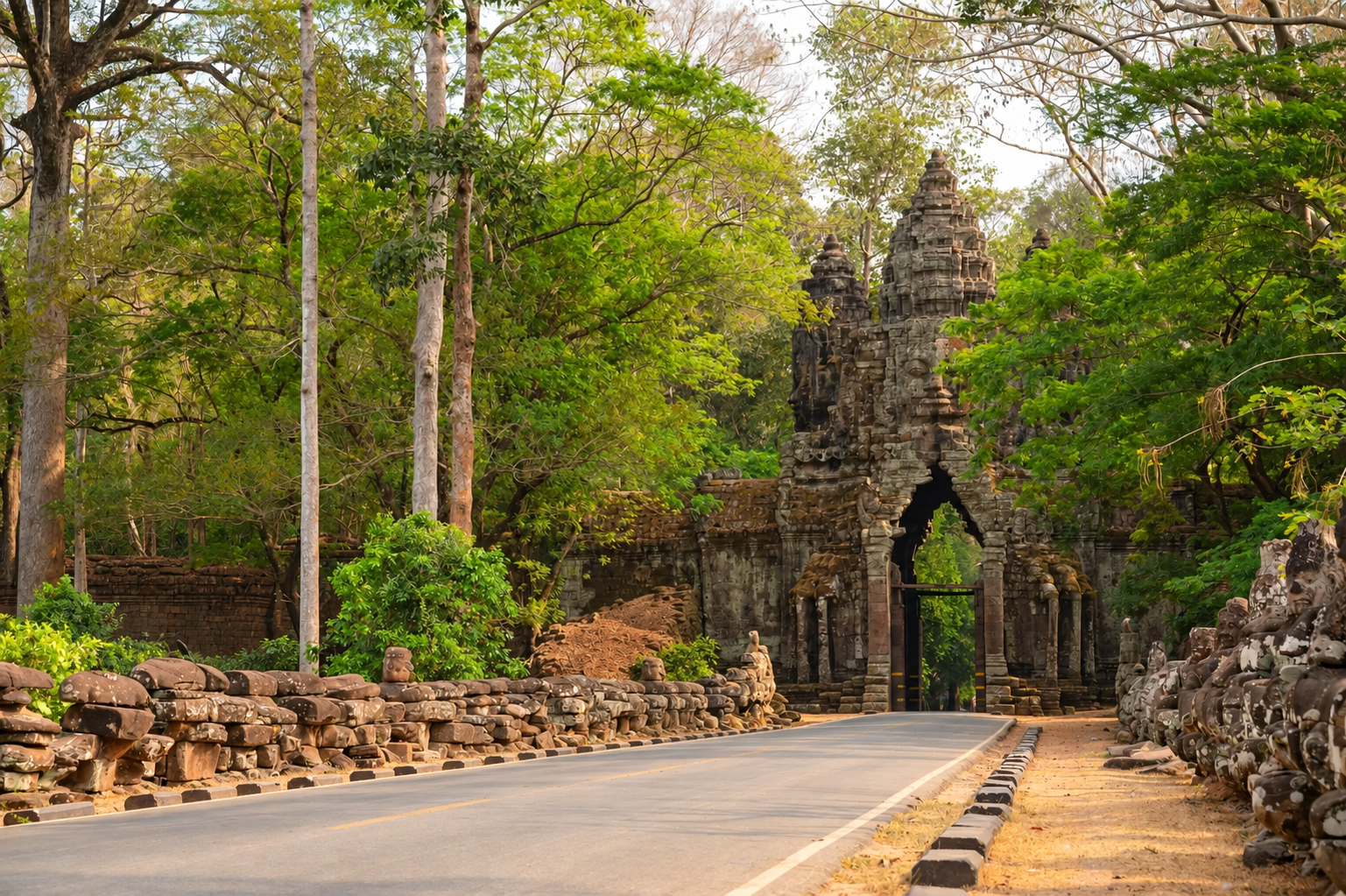
This is where I become interested in the word portal. I don't know whether I mean it literally. Maybe I don't need to decide. A portal is something through which we pass and are no longer standing in exactly the same reality we occupied before. By that definition, human beings have always known portals. Birth is one. Sex can be one. Death certainly is. Grief can open one. Psychedelic states can open one. Ritual, extreme heat, fasting, prayer, music, breath and certain encounters with nature can temporarily rearrange the ordinary architecture of perception. Why would a place not be capable of doing something similar?
We already know that human beings build environments specifically to change consciousness. We lower ceilings to make a room intimate and raise them until the body feels small. We use darkness, repetition, rhythm, symmetry, acoustics, procession and restricted entrances. We make people walk a particular path before they arrive at the center. We build thresholds. We orient structures toward celestial events. We create chambers where sound behaves differently and openings through which light enters at particular moments. Long before anyone used words like neuroscience or environmental psychology, human beings understood that space does something to consciousness.
Angkor understands space... VERY WELL! You do not simply stand in front of it and receive information. You are moved through it. Across water. Over causeways. Through gates. Along galleries. Around walls covered with bodies, gods, battles, animals, celestial beings and stories carved into stone. You move from the horizontal toward the vertical, from the enormous toward the increasingly concentrated, until the architecture itself begins to feel less like a building and more like an instruction.
The body is being taken somewhere before the mind has decided what any of it means. And I think this is one of the keys to entering places like Angkor: stop thinking for a while. Stop trying to interpret every sensation as it happens. Stop asking what something means, whether you believe in it, whether it fits your worldview, whether you are imagining it. Let the body respond before the mind turns the experience into a story.
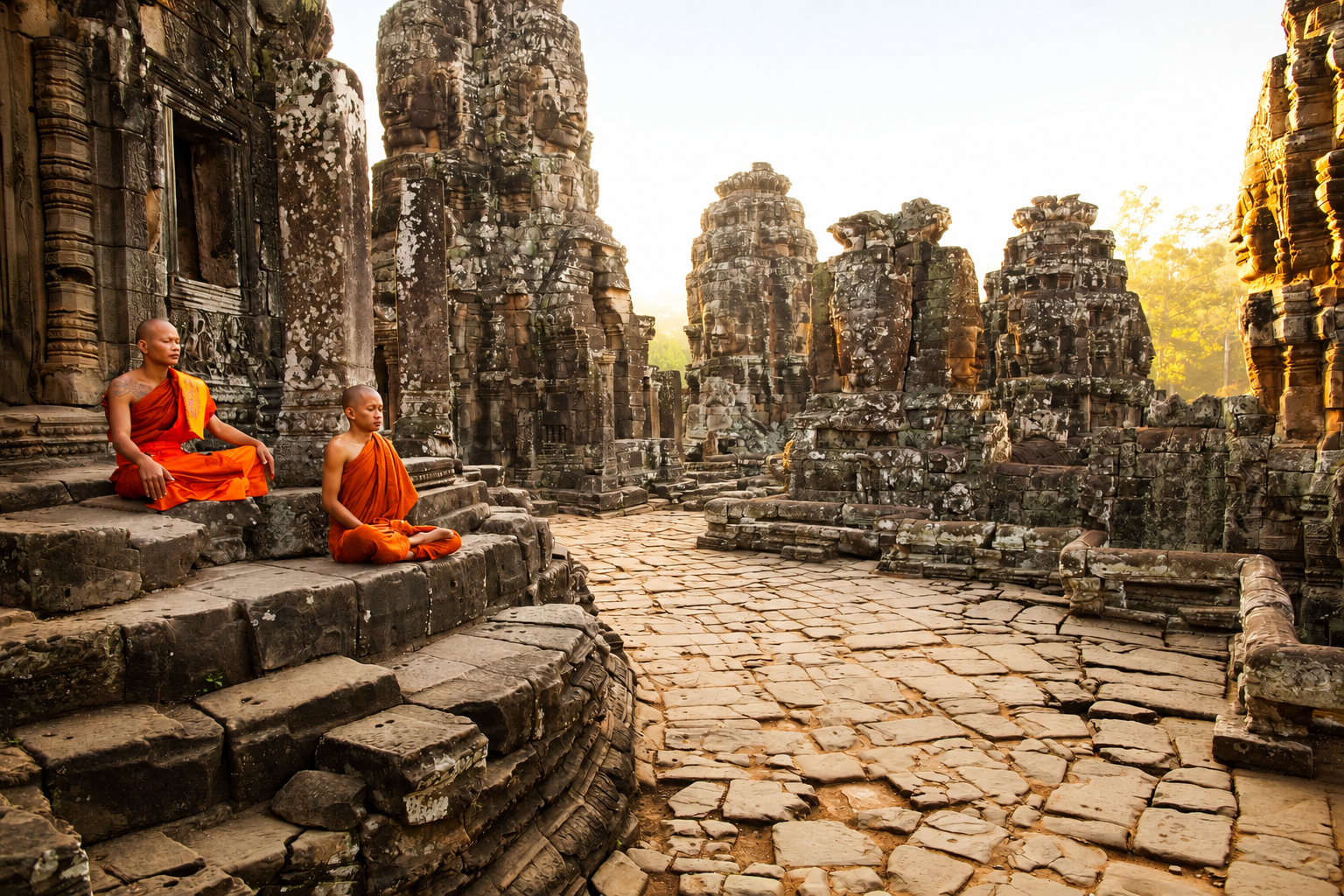
When you actually experiment with this, you may be shocked by yourself. You may find yourself doing things that seem completely bizarre from the outside: stopping in a particular place without knowing why, touching a certain stone, knocking in the center of something, suddenly turning around, walking in circles, walking only in the middle, sitting down at certain places with the gaze of a crazy person, moving your body in an unfamiliar way, crying when nothing sad has happened, feeling drawn toward one space and strongly repelled by another.
The mind cannot always keep up with the speed at which the experience is unfolding. There were moments in Cambodia when I had the peculiar sensation that I was both the woman doing these things and the observer watching this character called Alena move through them. And that is where it becomes fascinating, because you cannot hide from yourself quite as easily from that position. You cannot edit yourself quickly enough. You cannot manufacture the more reasonable version of what is happening. Something happens first, and only afterward does the mind arrive, slightly out of breath, asking, What the hell was that? We just don't know, do we!
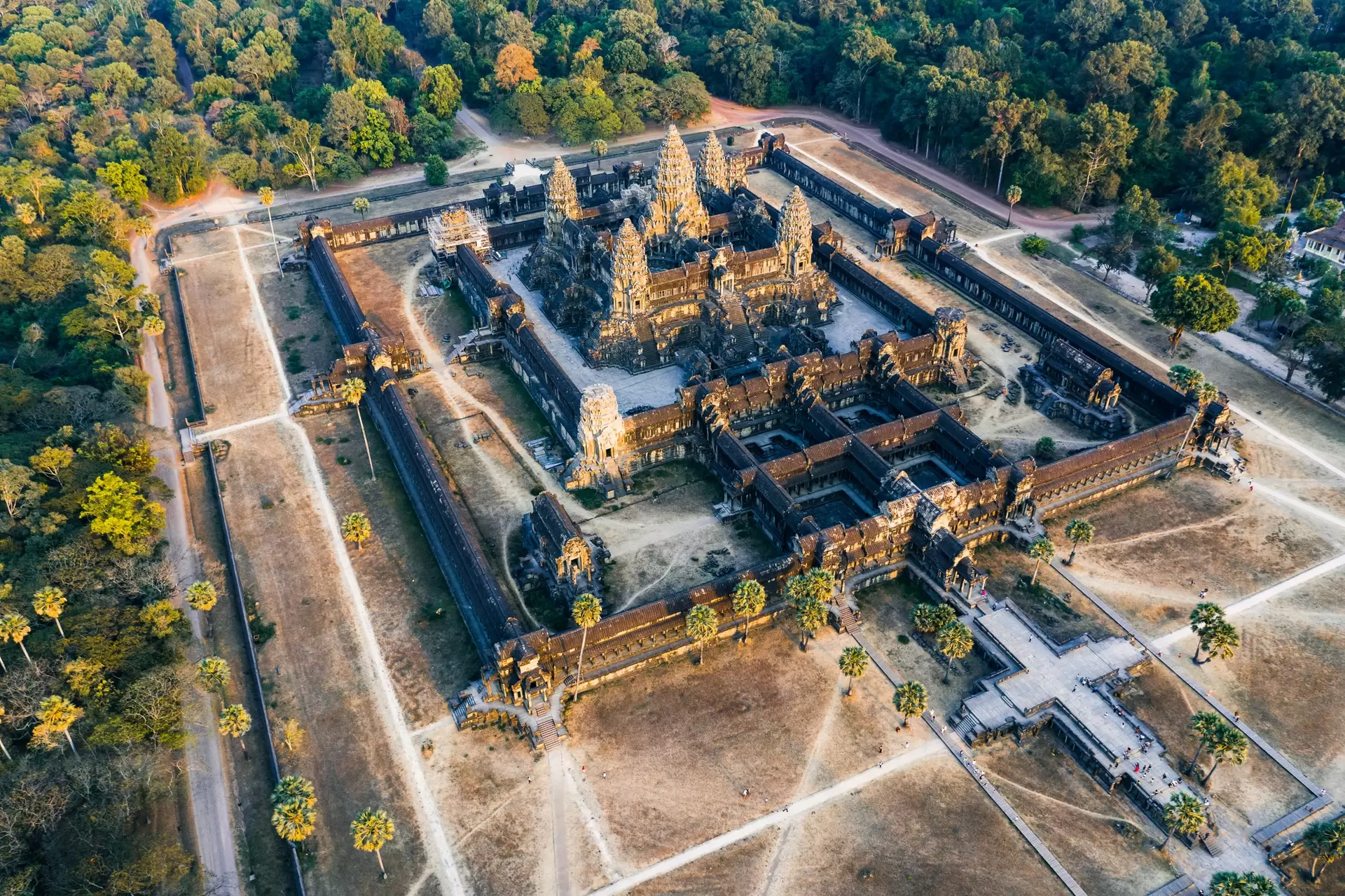
This is why the image of Angkor as some enormous circuit or information system does not feel entirely absurd to me. I don't know that I need to take the technological language literally. But when I look at Angkor from above and consider its geometry, water, orientation, repetition, pathways and central towers, I understand why someone might reach for metaphors such as a circuit board, receiver, transmitter or even a cosmic printer. These are modern words attempting to describe a very old possibility: maybe architecture can hold and transmit information without using language. Maybe information does not always arrive as a thought. Maybe sometimes it arrives as orientation, sensation, movement, recognition, resistance, attraction, an inexplicable impulse to stop here rather than there. Maybe the body reads something before consciousness knows how to translate it.
And maybe stone can hold memory too. The other day I was looking at the yantra of Saturn, Shani, the great karmic teacher in the Vedic tradition. A yantra is presented to us as a two-dimensional geometric image, but I suddenly began imagining the geometry vertically, giving it height, turning the flat pattern into form. And I stopped. I know this shape. What I saw immediately reminded me of the rising towers and roofs of Angkor.
I am not presenting this as archaeological evidence that Angkor Wat was secretly constructed as a three-dimensional Saturn yantra. I am describing the recognition that occurred in me, because the symbolism was almost too perfect. Shani is associated with time, karma, limitation, discipline, consequence and those encounters with reality from which clever explanations can no longer rescue us.
Saturn is not necessarily the cruel teacher we sometimes make him into. He is the teacher of what is. You may want another answer. You may prefer another timing. You may have an elaborate story about how things should unfold. Shani keeps bringing you back to the structure, the consequence, the boundary, the fact. Shani will show you your own "shit" in the middle of the living room that you covered up. Shani will bring you there and say: "See? This is why it smells bad! Clean it up."
And this is exactly why my immediate thought was: Shani is there. Not necessarily as a planet secretly operating the machinery of Angkor, and not as something I need anyone else to believe. I mean that I recognized the signature of the teacher.
Cambodia did not give me what I expected from it. It kept directing me toward what I needed to encounter, sometimes before I understood that I was being directed at all. That is a very Saturnian form of guidance. It doesn't always arrive as revelation. Sometimes it arrives as a wall. A delay... A limit... A strange attraction! A wound on your knee... An encounter you cannot explain. A reality you can no longer negotiate with. Something that makes the old story impossible to maintain.
Maybe this is why certain places can feel so intelligent. They don't necessarily tell us anything. They position us. They put the body here instead of there. They slow us down, disorient us, attract us, confront us, and occasionally create conditions in which we can finally see something we have been perfectly capable of avoiding everywhere else. Whether we call that sacred architecture, nervous-system response, ritual technology, planetary symbolism, memory held in place, or something for which we do not yet have language matters less to me than it once did.
I know what happened to me there. I stopped being able to pretend that I didn't know what I knew.
I don't mean that I can prove that a stone remembers an event the way a brain remembers breakfast. I mean something both simpler and stranger. Places accumulate human presence. Millions of feet follow the same paths. Hands touch the same surfaces. Generations pray in the same chambers. Bodies bow in the same direction. Fear, devotion, violence, longing, death, coronations, abandonment, rediscovery and tourism all happen within the same physical container. Even if we remove every supernatural explanation, a place can become saturated with human meaning.
But standing at Angkor, I kept wondering whether human meaning was the whole story. Because sometimes a place feels older than its history.
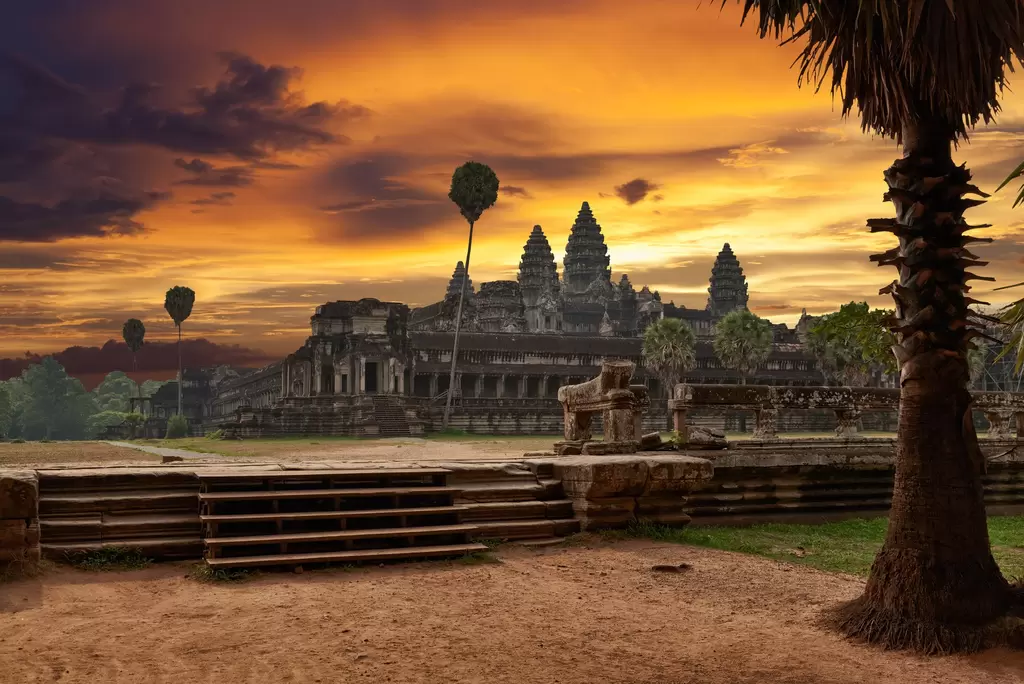
That sentence makes no archaeological claim. It describes an experience. I knew when Angkor Wat was built. I knew there was a historical civilization behind it, rulers, labor, religion, engineering and politics. And still there were moments when the date attached to the monument felt strangely inadequate, as though the twelfth-century structure were sitting on top of something much older that I could not identify.
Maybe that "something" was geology. Maybe it was landscape. Maybe it was the accumulated symbolic power of the place. Maybe my mind was responding to scale, geometry and expectation. Maybe cultures choose sacred sites because human beings have always been unusually sensitive to particular combinations of water, terrain, horizon and sky. Maybe there is a great mystery behind this enormous temple...
Or maybe there are dimensions of place that we have not yet learned to measure.
I can live with the maybe. In fact, Cambodia taught me to become much more comfortable there.
One of the descriptions I recently read said that Angkor contains hidden libraries, information encoded into its walls and proportions, records of human evolution waiting to be read. Again, I cannot tell you that this is literally true. But I know what happened to me among those walls: they produced information... Not sentences! Not secret historical facts downloaded into my brain! They brought things to the surface.... Memories, questions, recognitions, emotional material, strange familiarity, inner knowing I have never felt before, and a deep recognition I've never felt before.
Things I had been able to think about intellectually elsewhere became physical there. I felt why I moved to the US 26 years ago... and I "knew" why I "came back home" to Siem Reap... it felt like I knew that I needed to bring certain people back there. I had an inner knowing of who they might be... of course, free will is there and me knowing may not be their path...
This is another way to understand an ancient library. Maybe not everything we inherit is meant to be read with the eyes.
The strangest part of my experience in Cambodia was the familiarity. There were places where I did not feel that I had arrived somewhere exotic. I felt that I recognized something. This is difficult to write about without immediately reaching for reincarnation, ancestral memory, past lives or some other explanatory system. Maybe one of those frameworks is correct. Maybe none of them are. I only know the experience itself: I felt at home somewhere I had never been. That fact interests me more than any explanation I can attach to it.
Then came the equinox at Angkor Wat. We were there at a time when the architecture and the movement of the sun enter into their ancient conversation. And during that experience, a rhinoceros hornbill landed on the central tower. Later, a local woman arrived, THANKED us for what we did for her land, and blessed our group.
I can list these events as coincidences. Nothing prevents me from doing that. A bird landed on a building. A woman encountered a group of travelers. The sun rose where celestial mechanics dictated it would rise. All true. And still, standing inside the experience, the events did not feel separate.
This is where the rational mind becomes impatient. It wants a verdict. Was it a sign or wasn't it? Was the place communicating or weren't you simply projecting meaning onto random events? Is Angkor a portal or is it an extraordinary temple complex built by human beings in the twelfth century?
I no longer feel obligated to answer.
Maybe our mistake is assuming that only one layer can be real.
Angkor Wat can be an extraordinary achievement of Khmer civilization and something that alters consciousness. Its astronomical relationships can be understood mathematically and experienced as sacred. A bird can be a bird and arrive at a moment that becomes meaningful. An architectural passage can be made of sandstone and function psychologically as an initiation. A place can have a documented history and still produce experiences that history cannot fully explain.
The material does not have to cancel the mysterious.
This is what I was sensing when the temples felt alive. Not necessarily machines hidden beneath the jungle or literal streams of information arriving from Sirius. I cannot claim any of that. What I can say is that certain places seem to organize human attention with extraordinary precision. They quiet some parts of us and amplify others. They interfere with our ordinary sense of time. They make symbols feel less like ideas and more like encounters. They create conditions in which something normally buried beneath the noise of everyday consciousness becomes perceptible.
If someone wants to call that sacred geometry, I understand why. If someone wants to call it a portal, I understand that too. If someone wants to describe it entirely through architecture, astronomy, history and psychology, I can understand that language as well.
What interests me now is not which vocabulary wins.
I am interested in what happened.
I entered Cambodia thinking I was traveling to another country. Somewhere along the way, the relationship reversed. I stopped feeling that I was studying the place and began feeling that the place was studying me! It was "talking" to me! Things I had carried for years became visible there. Questions changed shape. Certain stories lost their authority. Something about my perception became less rigid.
Maybe this is what sacred places have always done. Not hand us answers. Rearrange the person asking the questions.
And maybe that is why descriptions of Angkor as a living portal don't sound entirely ridiculous to me. I don't need to believe every cosmological detail attached to them, even though I do in some parts of me. I don't need to know what lies beneath the temple or which constellation someone believes communicates through its stones, even though I do somewhere inside of me. I definitely don't need to convert an experience into doctrine.
I only know that when someone says: "There is more happening there than what you can see," something in me recognizes the sentence.
Because I was there!
And I felt it!
Maybe the temple opens it in us.
Maybe the real mystery of places like Angkor Wat is not that they contain some secret technology waiting for humanity to become advanced enough to activate it. Maybe the technology is already operating. Maybe it has always been operating through stone, water, proportion, darkness, sunlight, sound, movement, symbol, the human nervous system and whatever else we still do not understand about consciousness.